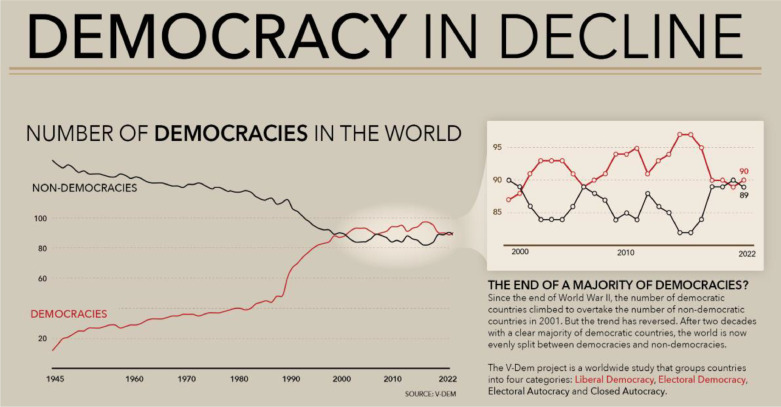
Spread of democraties
30 December 2024 ·
It is good to see what is happening in Syria, because it is a small light in the darkness. Unfortunately, the global picture tells a different story. If we look at the development in the number of countries with democratic governments, it rose during the end of the colonial era in the latter half of the last century, and rose particularly sharply in the decade after the fall of the Berlin Wall in 1990. After 2001, there was a significant change in the curve. Since the United States, with Denmark's support, launched the war against Islamism and terrorism in 2001, there has been no further global increase in the number of democracies in the world. Although the stated aim has been to strengthen the democratisation of the world, the effect has been the opposite. In fact, the situation is worse than the graph shows, because it is mostly small countries that are becoming democratic, while de-democratisation is most evident in larger countries, so the number of people living in democratic countries is actually falling, and even though half of the world's countries are democratic, only 28% of the world's population currently lives in democratic countries, which is the same level as in 1987, i.e. before the fall of the Berlin Wall. There are probably several reasons why democratic countries choose to fully or partially de-democratise their social institutions, as seen in the United States, Russia, Hungary, Israel, Turkey and many other countries, but according to a recently published article in Explorer, it is primarily due to a general increase in fear in the collective consciousness of society. https://www.sciencedirect.com/.../pii/S1550830724002118... Fearing the biodiversity crisis, climate change, and other issues, people seek reassurance from authorities who promise radical change with great conviction and are less likely to vote for politicians who resignedly acknowledge that it is probably not realistic to do anything about the problems, even if they may actually be right. ‘You don't need to be worried about it. I'll take care of it. I'm going to take care of it. I know how to fix it.’ Although neither Trump with this quote nor, for that matter, Mette Frederiksen have any realistic plans to solve any of the world's most serious challenges, they are elected because they appear to be strong leaders. In a world of insurmountable problems, people seem to prefer a leader with the wrong solutions to a leader with no solutions at all. Whether the fear in society is well-founded or not, it is reinforced by social media. Social media, including this post, will tend to focus on problems rather than bright spots even more than tabloid newspapers, thereby contributing to increased fear in society. The decline of democracies around the world is thus also an effect of the information society, including the misinformation society.
Comments
Be the first to share a thought
Start the conversation with a thoughtful response.
Join the conversation
Sign in to leave a comment and keep the discussion flowing.
Further reading

I applause the increase of oil prices!
It is always tragic when people die, whether they are an ayatollah, a soldier, or a civilian, and it is repulsive to wit...

pesticide residues in drinking water
Of course, we should ban the spraying of toxic chemicals on the land above our drinking water. When the issue is raised...